Co-author — the first AI-native development methodology
Supervised Engineering & Normative AI Regulation. A formalized approach to managing AI agents in software development: roles, quality gates, metrics, knowledge capture.
senar.tech18+ years in IT. Built departments from scratch and ran SRE and DevOps teams of up to 15. I build systems end-to-end together with AI agents and set up how teams work with them. Co-author of the SENAR, RENAR and PHASE standards.
AI-generated video
So you can tell whether this is your case — not just what I can do
Projects with no direct access to the people who make decisions. Through three layers of sign-off I cannot be accountable for the result — and I want to be.
I build the entire product: backend, frontend, billing, monitoring, deployment. You get a working service, not a set of components.
I analyze existing codebases, write technical documentation, migrate infrastructure to IaC. New developers onboard in days, not months.
Web apps, desktop utilities, workflow automation. I work with complex domains and build products that non-technical users can understand.
I set teams up to work with AI agents: where an agent speeds you up, where it lies, and how to verify the result. I review architecture and help you commit to a decision.
Embedding AI into business processes: model fine-tuning, RAG systems, multimodal pipelines. From prototype to production with real metrics.
Designing infrastructure from scratch, auditing existing setups. CI/CD, monitoring, IaC, hybrid clouds. Building platforms that scale and don't depend on a single person.
Three normative documents on engineering in the age of AI — from development methodology to enterprise architecture
Co-author — the first AI-native development methodology
Supervised Engineering & Normative AI Regulation. A formalized approach to managing AI agents in software development: roles, quality gates, metrics, knowledge capture.
senar.techCo-author — requirements engineering for AI-native development
Requirements Engineering and Normative Adaptive Regulation. Requirements, specifications, test cases and adaptation artifacts for projects where AI agents write the implementation. Works standalone, interoperable with SENAR.
renar.techCo-author — the architecture of the cyber-enterprise in the age of AI
The enterprise as an automatic cybernetic system: all application logic is expressed with three primitives — phase, spawning, subscription. A human and an AI agent change an object's state through the same mechanism, and the degree of autonomy is a setting rather than an architectural rewrite.
phaseconcept.techA standard taken all the way to executable code
SENAR and RENAR implemented as a working tool: an agent cannot edit files without an open task, nor close one without evidence. 1197 tasks closed, 7115 tests, 76% coverage, Apache 2.0. This site was built under it.
Selected examples — from SaaS to system software
SaaS for semantic bookmark search. From idea to production in 6 weeks: auth, AI categorization, vector search, billing — one developer.
EdTech SaaS in 8 weeks: AI tutor, learning material generation, progress tracking. Self-hosted LLM — zero external API costs.
A two-player game by the classic rules: matchmaking, private rooms, three AI levels and ratings. No sign-up, straight in the browser.
A co-op factory game in the browser. A crew of one to four fills the quota in a six-minute shift, fixes a stalled line and rigs a bypass chute; empty seats are taken by trainee robots. Interface in Russian.
Brands don't know how ChatGPT, Gemini, and DeepSeek talk about them. Connected 8 LLM APIs, automated data collection and analytics, billing via CloudPayments.
A .NET 4.0 system evolved over 12 years with no documentation. Created 49 architecture docs, API reference (78 commands), RAG search, and a VSIX plugin. Onboarding time reduced dramatically.
Lyrics in, a sung song out — entirely on a local GPU, no cloud. Three singing engines, with quality checked automatically: the vocal is transcribed back and compared against the source lyrics.
Building a corpus of your own voice to work with AI, plus analytics across groups and channels — from short recaps to participant profiles. Meaning-based search, with models running locally so the conversation never leaves the machine.
A general-purpose platform where AI agents do the legal work: document analysis, drafting case positions, tracking deadlines and internal policies.
Estimates outcome probabilities and compares them with the bookmaker line — the gap is the betting candidate. Facts about teams, players and injuries are stored with the date they became known, so the model never learns from what nobody knew on match day.
Custom engine: 8 protocols, DPI bypass, ~5 MB. 4x more compact than Go alternatives.
Promo website + AI movie poster generator for a premium design studio. Multi-provider generation, upscale to A2, print-ready output.
Real-time World of Warcraft chat translator. Addon memory reading via ReadProcessMemory, click-through overlay, <1 sec latency.
Bluetooth manager: A2DP/HFP switching, LDAC/aptX encoder in Rust, auto-mode by application.
Telegram bot: hierarchical chat history summarization, daily digests, context search. Multi-LLM (Claude/OpenAI/Ollama).
Windows app for real-time network process monitoring. Packet capture, domain grouping, traffic statistics.
An autonomous knowledge and education server: AI chat, libraries, maps — all without internet. A derivative of Project N.O.M.A.D. (Apache 2.0).
Document signing with integrity verification, deployed as a container.
Full pipeline: script → voiceover → video → editing → auto-posting. Zero manual work.
Batch processing up to 4,480 pages. Hours of manual work replaced by minutes of generation.
Model trained on 500+ texts + RAG search. Draft articles in brand voice generated in minutes.
Grid-trading bot with 3 AI analysts (GPT/Claude/Grok), Telegram control, emergency stoploss, and auto-reports.
Text and image generation via YandexGPT/ART, moderation, auto-posting to Telegram, VK, Zen.
5 bots: Yandex Cloud billing monitor, support ticket system, AI tarot/horoscopes, recipe finder by ingredients, trading management.
12-step report form, materials and road marking tracking, 6 roles, auto-sync when network appears.
Legacy CRM infrastructure research for service industry: 9 modules (widget, SMS, WhatsApp, product marking, medical integrations) using AI tools.
Full cycle with AI-native engineering: design, deployment, operation — at any scale. You get infrastructure described in code and documented, not handed over verbally.
Automated employee performance reports and intangible asset tracking. Integration into existing Redmine.
Docker-based location tracking system with 9 collection scenarios and Telegram bot management.
Removes the manual routine around the land registry: addresses normalised to an accepted form, cadastral numbers enriched, territory plans processed in batches. A desktop app built for the clerk, not the programmer.
Tracks cash flow: what you have, how long it lasts, and where the plan diverged from reality. Proper accounts and transfers, with AI sorting expenses into categories.
A call or chat. I dive into the business context, capture requirements and constraints. Decomposition, timeline, cost — fully transparent.
I write code, set up infrastructure, deploy. Using modern tools and automation — I work as three without sacrificing quality.
Weekly demos. Code in your repository. Documentation, tests, and deployment included. You don't depend on me after handoff.
18+ years: from Perl developer to Head of Division at Gazprom-Media
Head of Division
Development and deployment of AI solutions for technology process analysis. Built an intelligent analytics system that improved decision-making transparency.
Head of Infrastructure Development
Built the department from scratch (5 people). Designed PaaS platforms and Infrastructure as Code model. Infrastructure integration during M&A deals — merging systems of combining companies.
Head of Infrastructure Development
SRE+DevOps team of up to 15, 100+ servers, 2 Gbit/s traffic. Refactored infrastructure and freed massive resources: 340 CPU cores, 2 TB RAM, 17 TB storage. Hybrid cloud, monolith → microservices, SLA/SLO for business. Speaker at DevOpsConf.
Founder & CEO
Digital solutions for brands and agencies: promo, analytics, CRM, BTL. 100+ projects, team up to 15. Clients: McDonald's, PepsiCo, Volkswagen, Disney, EA Games via Leo Burnett, Seven, and other agencies.
El Pako (interactive installations), KOKOC Group / Elitoid (CTO, high-load), Buongiorno Digital (Webenabling TM; P&G, L'Oreal, MTS), RBS Corporation (Senior Perl Developer).
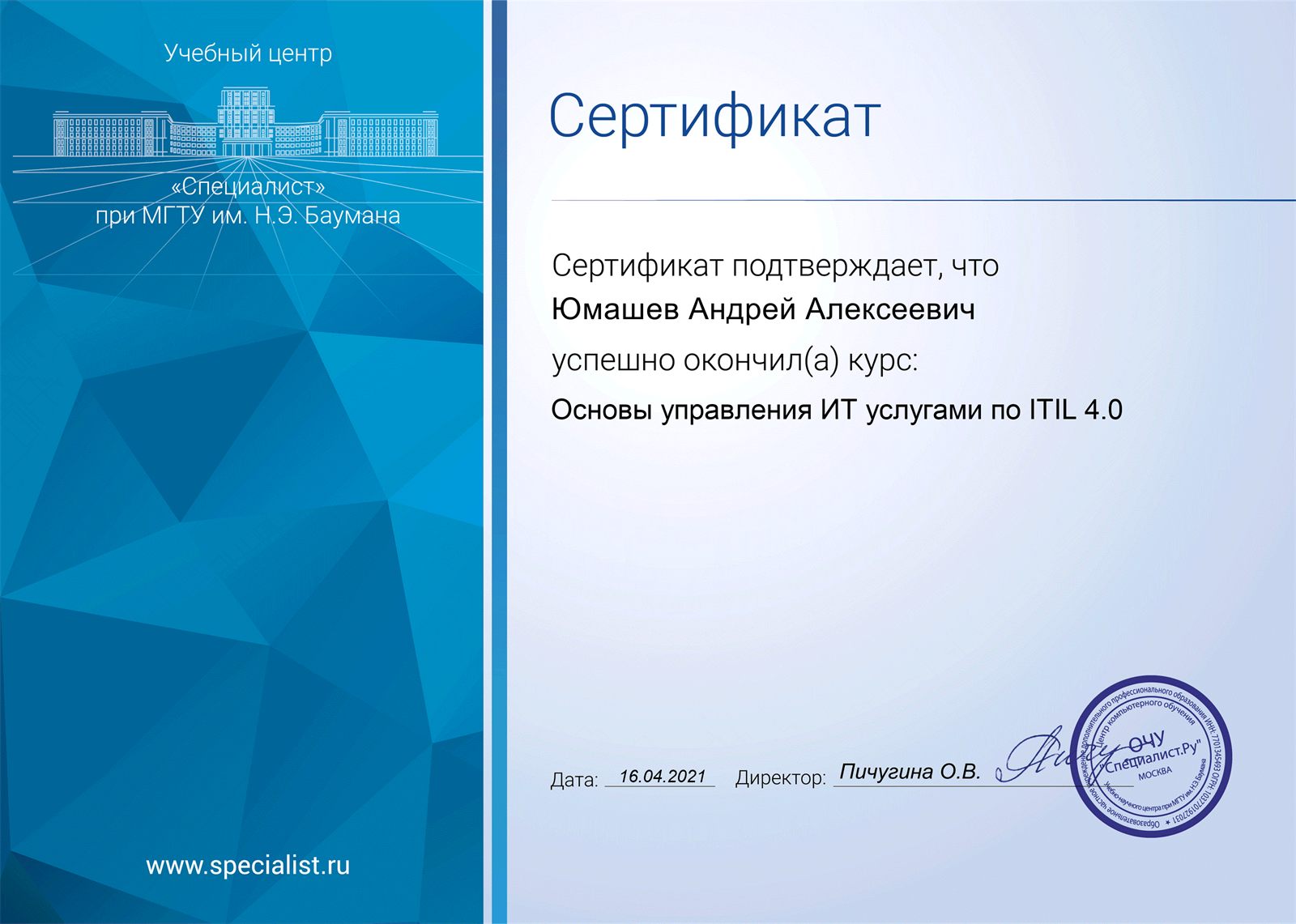
IT Service Management Fundamentals with ITIL 4.0
Specialist Training Centre at Bauman Moscow State Technical University, April 2021.
ITIL 4 service management: the service model, service levels, incident and change management — the vocabulary a client uses to describe operations rather than development.
Sharing experience at conferences and in professional media
Setting up cross-team communication. Talk at tceh accelerator (Moscow).
Talk at DevConf 2019. Video on YouTube.
Talk at Russia's main DevOps conference. Video on YouTube, transcript on Habr.
"Cloud and Platform Services" conference. Building a PaaS platform, comparing approaches.
Opening piece of the series: why a rulebook is not enough and what discipline the work actually needs.
What an agent can and cannot do, and what follows for a team putting one into production.
The engineer's role shifts from writing code to framing tasks, reviewing, and designing the agent's context.
The SENAR methodology: a formalised entry, control gates, and measurable definition of done.
Managing context, drawing architectural boundaries, and keeping project memory across sessions.
Where fully agent-driven development ends and what stays with the human.
Reading game chat out of another process's memory: region scanning ate half a core; a numeric anchor in a Lua table cut the overhead to 0.1%.
Articles marked RU are published in Russian — the six-part series on working with AI agents is complete, and all parts are linked above. Also: "Na Stachku" (Innopolis, 2020), private Rostelecom conference (Voronezh, 2019), and other industry talks.
One per role — what exactly I do
As a developer — when you need a working product and have no team for it: I take the whole thing, from architecture to deployment. As a manager — when the team exists but the process does not hold: building a department, owning infrastructure development, setting up work with AI agents so the result can actually be verified.
The bottleneck moves from writing code to verifying it. An agent produces plausible output faster than a human can read it, so you need formal gates: a task before code, evidence before closing, dead ends written down. I described this in the SENAR and RENAR standards and implemented it in TAUSIK, a tool that refuses to close a task without evidence.
We work on your code and your process: where an agent genuinely speeds things up, where it lies confidently, and how to tell the two apart. The outcome is a working set of rules, not a retelling of blog posts. Format and scope depend on team size and are agreed separately.